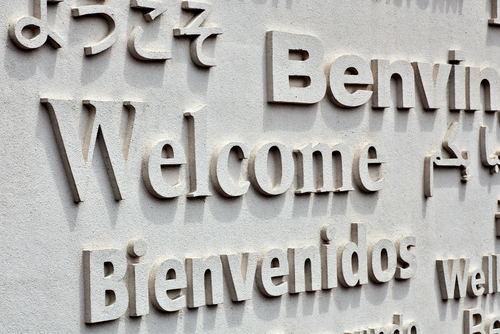
The United States is home to the fifth highest population of Hispanics in the world. As of 2009, 44 million Hispanics lived in the U.S. and this number is expected to increase to over 100 million by 2050. Not surprisingly, Spanish is the second most common language in America. Spanish isn’t the only language that’s growing in America. Chinese is the third most common language in the country, followed by French, then German, Tagalog (spoken in the Philippines), Vietnamese, Italian, Korean, Russian, Polish, and Arabic.
With so many languages and cultures flourishing in the U.S., businesses, colleges, government organizations, and others feel that being bilingual, or even multilingual, is an asset. In many instances, companies will hire a bilingual or multilingual candidate over one that speaks only one language—even if the candidates’ backgrounds are nearly identical.
In addition to being a plus in the working world, there are a number of jobs for individuals with a degree in foreign language. These jobs are available in education, government, aviation, law, the arts, finance, journalism, tourism, social service, customer service, and many others. Just a few job titles for foreign language graduates are foreign service officer, foreign service peacekeeping, air-traffic assistant, paralegal, art dealer, importer/exporter, professor, consultant, international banking officer, cultural attaché, linguist, interpreter or translator, customs/immigration officer, travel writer, foreign exchange trader, UNESCO official, and foreign diplomat.
While a foreign language degree is the minimum requirement for some of the positions listed above, a degree in say finance, along with fluency in or a certificate in a foreign language might be the only requirements. If you already speak a second language such as Spanish, but have never taken a Spanish class, that doesn’t mean you can teach Spanish. In a language program, you’ll learn the technical aspects of the language and the proper way to speak it.
The type of foreign language program you should take will depend on what you plan to do once you’ve learned a second language. If you plan to learn a second language for personal growth, taking a foreign language program at a language center or community college may be sufficient. If you prefer to work independently, you can purchase any number of language learning software packages online or at your local software emporium, bookstore, or electronics store. If you plan to make a career of it, a foreign language program at a two- or four-year college is your best bet.
Some of the best colleges for foreign language majors are:
- -Georgetown University
- -University of Chicago
- -Harvard University
- -Princeton University
- -Columbia University New York
- -Stanford University
- -Brown University
- -Tufts University
- -University of Colorado
- -Southern Methodist University
- -Dartmouth College
- -Brigham Young
- -University of California-Berkeley
- -University of Pittsburgh
- -University of Rochester
- -Duke University
- -Vanderbilt University
- -The University of Texas
A Bachelor of Science or Bachelor of Arts in Foreign Language takes four to five years to complete. Colleges that offer the program online may offer the option to take an accelerated program, which means, you can complete the program in two to three years, with no breaks.
For more information about language in America, visit the U.S. Census Bureau Language Use page at http://www.census.gov/hhes/socdemo/language/.
